
By: John Faussemagne
The following is something I wrote during my freshman year of college in December of 2023 while residing in Washington, D.C. I would also like to add that all photography was taken during the course of my review, which is why it appears so shaky.
When Honestly, Nevermind by Drake came out, it was critically panned. However, one specific commentator in the hip-hop community defended Drake under the pretense that everyone wasn’t listening in the right space. The average person listening to this album was hearing it for the first time while listening in bed or on the car ride to work. A house-focused album isn’t meant for these settings, but is something made for the dance-floor, far away from where most people were listening. While this album didn’t leave a lasting impact on me, the idea that music is made for a space did.
Earlier this semester [fall 2023], I went through Scott Walker’s discography to hear the crazy, weird, and eclectic turn his style took. In his early career, Scott was recognized for his crooning, baroque pop that made up the successful albums Scott 1, 2, and 3, and his prior work alongside the Walker Brothers. His solo projects feature many covers from the legendary French singer Jacques Brel. The fourth album in the “Scott” series, Scott 4, however, was not so successful, failing to top charts as the first three did (despite being the best one in my opinion). After years of trying to recapture this success, both solo and regrouping with the Walker Brothers, his career stalled. When he came back in 1984 with Climate of Horror, Scott had a much darker tone, which continued even further in 1995’s Tilt. By the turn of the century, the once beloved voice had turned into a manic, industrial, avant-garde singer-songwriter.
11 years after Tilt, Scott returned with The Drift in 2006, an album diving even further into the experimental rabbit hole. The album is often considered one of the scariest projects ever conceived, and remembering the note about listening in the right setting, I decided to wait till late at night and listen alone in the darkness. While I did enjoy this album, the darkness of my room didn’t prove as horrifying as I hoped, so I searched for new methods for the equally scary follow-up project, 2012’s Bish Bosch. The next day, after classes ended, I contemplated what setting would fit the album, and decided to take the Metro to Theodore Roosevelt Island, a forest area and trail near DC. To fully experience the album, I set my headphones to noise-cancelling to block out any other sounds I might hear from the outside world. I couldn’t rely on my hearing for anything, having to depend solely on my eyesight. I started the album right as I was leaving campus and getting on the metro, partially to feel how the album devolves into darker themes as I go from the safety of my dorm to an unknown forest.
As the drums in “‘See you don’t bump his head’” abruptly came in, I started my journey. I recognize it was sonically frightening, but I didn’t feel any sense of dread; this, however, changed during the second song. As I got to my stop and started walking to the forest, “Corps De Blah” commenced. The violins and noises bounced around my head, and I missed the feeling of safety offered at home. It took a second to feel truly scared, but now I was far from the city and approaching my destination fast.

Theodore Roosevelt Island Entrance
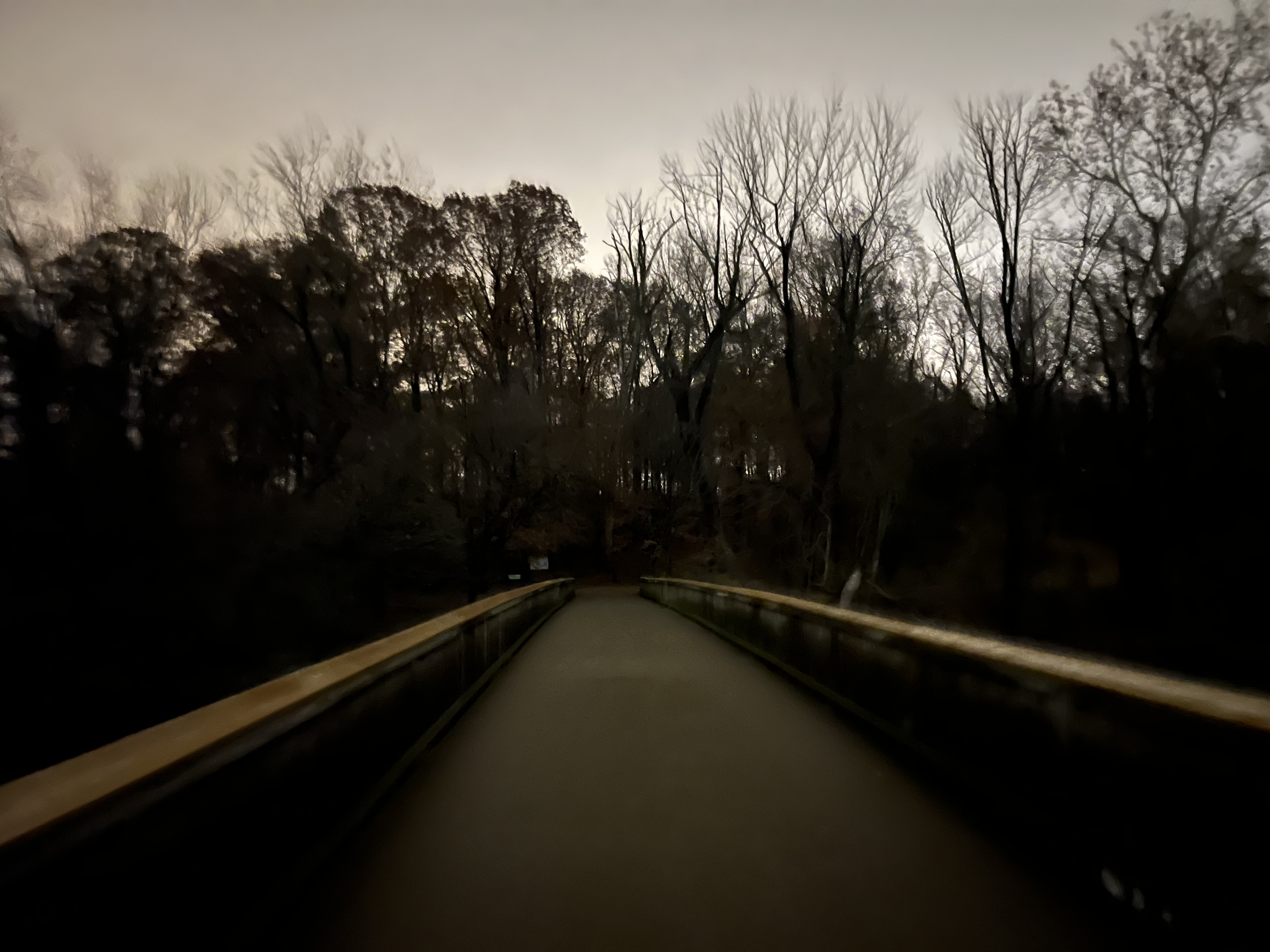
As I reached the gate of Theodore Roosevelt Island, “SDSS1416+13B (Zercon, a Flagpole Sitter) started playing. A bridge past the gate over water led me to the forest. The sky was a burnt orange from the light pollution and the city around me, alongside the recently departed sun. I could clearly see the forest ahead of me. The lifeless trees had lost their leaves during the fall season and appeared twisted and demented as Scott talked into my ear. The song starts with Scott by himself, no instrumentals, but as the guitar slowly repeats itself around the 1:50 mark, I was facing the entrance to the forest. The guitar chord changed, and I stood in genuine horror seeing what lay ahead. The forest was dimly lit by the same burnt orange sky, and you had to truly focus to see what was in front of you. I finally mustered up the courage to walk into the woods.
The entrance was disappearing behind me, and I was now breathing incredibly fast as my stomach began to sink. The headphones cut me off from the outside world, making everything I saw ten times more frightening, as I couldn’t rely on my hearing, which was being bombarded with chaotic and harsh noises. I turned from one path to another, where a man ran past me. I jumped and immediately entered fight or flight, believing myself to be in imminent danger. I let out a shriek as the man ran along, not noticing my horror.
The scariest and best part about this album is that it truly brings you into its world. I was no longer in this forest, which I had gone to in the city I lived in. I was now in the demented plane which the album exists in. I continued down the path before encountering massive statues of Teddy Roosevelt, where I stopped for a few minutes to take a breather and settle myself from the scare minutes earlier.


Theodore Roosevelt Monument
Sitting down, continuing the album was unhelpful in calming my nerves as I sat jittering and quickly glancing in every direction possible. The shadows of the trees, sharp and deadly, lurked in every direction, making it hard to focus as the 22-minute-long song creaked in my ears. I began to lose my sense of self, not sure whether the noises were the product of my headphones or the outside world. Despite the disoriented feeling, I continued, making my way to a new trail on the island. Every step began to feel like a world of pain. If I looked down I could make sure no snakes slithered up to surprise me, but I would be leaving myself vulnerable to anything that jumped out right in front of me. Surely I was overthinking myself, but the strings and Scott’s voice continued my struggle in using my mind to think… I looked down once again, then behind myself, I turned left, then forward again. To my right was a river–the Potomac to be specific–but it was the one direction I felt secure, believing nothing could jump at me. As I looked down again, from the corner of my eye, something ran in front of me–then another. Four baby deer jumped out in front of me, with their father, a massive buck, with horns two times the size of my head, following in the rear. The terror I felt from this jump-scare refused to leave my body. “SDSS1416+13B” continued to beat down on me as the four children scoured off, but one stayed. The buck stood ten feet from me in a standoff. The fall weather made it just cold enough for his sneering to appear visibly in the air.

While face to face with the buck, I attempted to take a photo, you can barely make the animal out in the center of the image
I intruded on their land, and this deer was ready to make me pay the price. I slowly backed up, maintaining eye contact and refusing to move anything but my legs, and the song relentlessly pounded down on me. My slow back-up turned to a run as I made my way back to the central area with the statue.
Time was not moving for me at all, and I was in the heart of the album now. The track “Epizootics!” followed and didn’t let up. The blaring horns kept me in a state of terror as I made my way to the exit. The song continued as I turned around to see another person who startled me, but instead of walking in the opposite direction, this man started walking towards me. I picked up the pace, trying to get as far away as possible, but it looked like they were getting closer. Maybe they were simply on a post-work run, but I was not in the right state of mind to believe that. I arrived at the same entrance I had walked through earlier, which was now much darker as the sun had completely set. I was out of the forest, hoping to calm myself down and try another trail while “Dimple” played. As I continued walking past the entrance, I kept remembering the eyes and sneering of the deer whom I had encountered earlier. When the ever-creepy violins came back at full volume, I made a rush for the exit, fearing the animals would come back. This however, wasn’t the end of the road. While I had only been in the forest for about 30 minutes, I hadn’t yet left the world of Bish Bosch. Everything that had mildly crept me out on my way in caused me to twitch and jerk on the way out. In my head, every person walking by minding their business was out to get me. I walked far from the forest, trying to get to Rosslyn (an urban area across the river from DC) as quickly as possible. Despite my earlier comfort in the area, the number of people, and my current mindset led to a deep sense of dread. The album pressed on, and my fear refused to leave, as more people didn’t mean safety; it meant more things to worry about.

I made my way deep underground to the Metro and hopped in as the final song, “The Day the ‘Conducator’ Died,” began. Now that I was in the corner of the train, I began to calm down as I could see everything and everyone around me. As I approached the campus and places I knew well, I grew calmer. The song approached the end, where the admittedly creepy Christmas bells started, before the album came to a close. When the album finished, Spotify began playing a random assortment of Scott Walker songs from earlier in his career. Where Bish Bosch scared me half to death, hearing tracks like “Matilda” eased my nerves. I walked back to my dorm when “It’s Raining Today” off Scott 3, from 1969, started, and everything came back. I had never noticed how creepy the violins were. Despite being a project from 43 years prior, the seeds of what was to come had already been planted, and I started looking around and shaking again. Certain similarities in his music, 50 years apart, remain, which is extremely cool that he could change so much, yet stay similar.
I wrote the following three years ago, and even upon editing, the feelings and visions I saw came back to me. Bish Bosch is a one-of-a-kind album that creates anxiety and dread, while also containing extremely interesting lyrical content. The album still stands up today not only in Scott Walker’s catalogue, but as an avant-garde masterpiece from the early 2010s. Scott’s experimentation, especially with his instrumentation, is unlike anything I have ever heard before. While some instruments are straightforward, he oftentimes finds new ways to create extremely weird sounds, which were documented in the 2006 documentary “30 Century Man,” which follows Scott’s illustrious career, and his making of The Drift.
The experience I had listening to Bish Bosch led me to truly want to place myself into the world of whatever album I was listening to, instead of lazily playing it in my car. When Ethel Cain’s Perverts released in 2025, I did something similar, going to an abandoned and possibly haunted house with a few friends to listen. For that review, check here.
Listen to Bish Bosch:
Spotify
Apple Music


Leave a Reply