
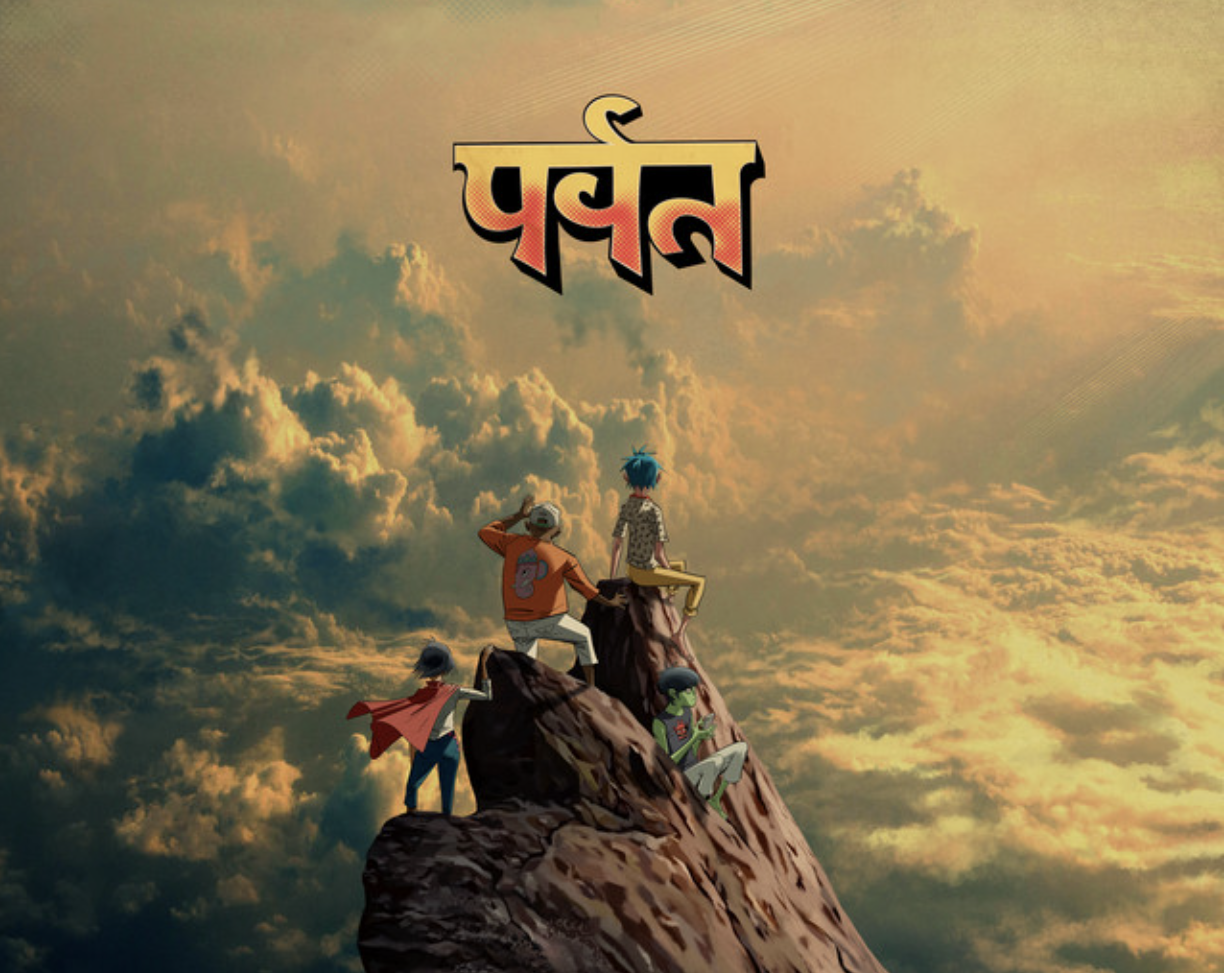
Sitting in my apartment, headphones on and laptop in front of me, I’m hopeful and prepared to undertake the endeavor that is the first listen of a new Gorillaz album. In this case, the album in question is The Mountain, released February 27th, 2026. Before I know it, I’m already on track 8, “The Manifesto,” a song that earns every second of its seven-minute and 19-second runtime, and I don’t want this record to end any time soon.
As a Gorillaz listener for nearly half my life, I’ve enjoyed recent projects like Cracker Island, but like many people, have also missed the thematic world-building that makes an album like Plastic Beach so special. Many fans have noted similarities to Plastic Beach, with some even calling the newest release a sequel to the 2010 LP, but I would argue that The Mountain stands entirely on its own in the band’s discography, acting as a natural progression of artistry rather than a derivative attempt at recreating past projects.
My personal favorite track is the previously mentioned “The Manifesto,” which feels like Gorillaz at the top of their game, opening with upbeat Latin hip-hop from Trueno before transitioning into a dark, brass-backed verse from the late Proof. Some other standouts are “The Moon Cave,” a catchy, synth-focused track and “Delirium,” which features an electronic take on a disco funk-inspired chorus with vocals from another late collaborator, Mark E. Smith.
Instrumentally, The Mountain draws inspiration from classical Indian music, evidenced by the opening title track. The track effectively integrates the sitar alongside an Indian bamboo flute and one-string violin, which sets the stage for an album that feels meditative yet melancholic in its tonality. Gorillaz co-creator Damon Albarn’s ability to seamlessly combine classical instrumentation with contemporary electronic and hip-hop elements creates a sound that is uniquely synonymous with Gorillaz, and that duality is front and center with this album, best embodied by the eleventh track, “Damascus.”
Lyrically, the album is thematically concerned with the afterlife, death, and loss, highlighted by the fact that many of the featured artists have now passed, such as Dennis Hopper, whose feature in The Mountain was recorded in 2010 prior to his death. The fourteenth song, “The Sweet Prince” leans heavily into the central themes and contains the lines, “Found myself by your bedside / Looking out across the void” and “The sword you hold in your hand / Well, its mighty blow will set you / On your patterned path into the next life” before leading into a melodic outro of flute and sitar instrumentation. The lyrical content of The Mountain stands out in Gorillaz’s discography as possibly the most vulnerable in the band’s history up to this point. “Empty Dream Machine” is a particularly devastating exploration of grief, and “Orange County” cushions the emotional weight of “The Hardest Thing” with an upbeat sound backed by seemingly optimistic whistling.
The collaborators featured here are absolutely phenomenal. Sparks on “The Happy Dictator” and IDLES on “The God of Lying” blend seamlessly into the atmosphere, creating a world that feels three-dimensional from a narrative perspective and sonically diverse from a sound-based one.
The last four tracks take a significantly slower approach as the album reaches its conclusion, which comes off slightly underwhelming given the infectious electricity of the first ten or so songs. “Casablanca,” while not unenjoyable, is easily the least memorable, and “The Shadowy Light” seems to go on just slightly too long past an ideal runtime.
The song most reminiscent of Plastic Beach is the final track, “The Sad God.” While Plastic Beach’s central themes primarily concerned the modern state of humanity and its effects on the environment, “The Sad God” depicts the perspective of humanity’s creator observing the growing pessimism of the modern world, referencing developments in technology and nuclear weapons in the past century. It serves as a cynically reflective sendoff to an album that contrasts the artistic, virtual fantasy of Gorillaz with the reality of life, death, and the modern world.
The Mountain is a quintessential Gorillaz album and an unexpected but welcome work of ambition and experimentation at this point in their career. It balances deeply personal lyricism with a distinct instrumental palette that never seems gimmicky or misused, and I would recommend a back-to-back listen for anyone who enjoyed the band’s earlier conceptual projects like Demon Days and Plastic Beach.


Leave a Reply